1.CONVERGING
FACTORS
The
stage is set for change.The
initial stages of the information age, instead of freeing us – as promised
– from a sea of paperwork; has in fact deluged workers with data and paper.
Inexpensive copiers, scanners, printers, fax machines and most of all,
e-mail systems have taken all effort out of sharing vast quantities of
data with a wide audience.Making
100 copies of a memo is now as easy as a single copy.E-mail
group lists make copying every employee a single operation, not even requiring
a person-by-person review of the recipient list.
Wireless technologies have been equally important in defining the information age to-date.Laptops; remote log-ins; wireless PDAs; car phone/fax/e-mail systems; global pocket-sized telephone and paging services, many now offering remote internet access are a few examples of the advances in technology which have impacted the workforce model.
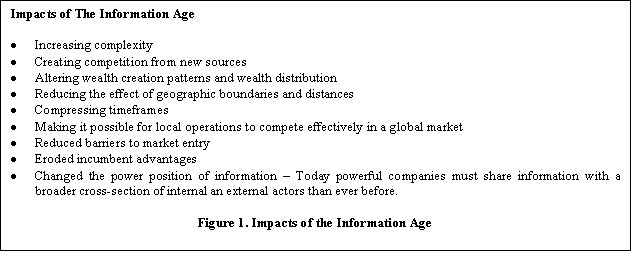
Shortened timelines add worker stress.The result has been a compression of decision making time, an increase in the number of tangentially relevant people adding input to decision making, and a loss of employee free-time.Employees are now available 24 hours/day whether they are in their car, at a little league game, or thousands of miles away on a business (or pleasure) trip.The screening, scheduling, and prioritizing functions once performed by administrative assistants has often been replaced by electronic applications that provide similar tools directly to the employee.This change has been aided and in some cases required by the last decade’s downsizing trend.The savings were easily quantifiable as whole positions were replaced by distributing tools and responsibilities among all workers.The costs of this aspect of downsizing are harder to quantify but are becoming increasingly apparent in daily business.
Additionally, employees are now asked to be a veritable jack-of-all trades since the traditional support staff is slim to non-existent in many companies.Employees, who once were paid to focus on strategy definition are now required to define the strategy, contact and organize the meeting attendees, produce meeting handouts, create the graphic elements, and even locate and schedule a free conference room.This means highly paid specialists are earning the same rate for performing less-skilled tasks such as meeting room scheduling as they are for developing project strategic plans affecting the bottom line.Looked at from the point of view of what a task is worth, the cost of so fully distributing such tasks to highly compensated employees becomes an expensive prospect.
Another well documented side-effect of the downsizing age is a loss of motivation in a workforce burdened with twin stressors of “survivors guilt” about remaining employed while so many around them lost established positions coupled with anger and resentment about being given the duties and responsibilities of all of those disbanded positions typically without any additional compensations.
Downsizing’s decimation of middle-management ranks leaves employees with a less defined promotion path, less old-style decision-making structures, and less clearly defined authorities.The advent of collaborative tools has been used to attempt to stopgap the decision structure and authority holes by involving more people in committee-based decisions.This has created its own stressors on the workforce by distancing employees from top management strategies, and adding a feeling of inability to effect change.
Shrinking Workforce.The aging of the baby-boomer generation now creates a natural loss of workforce through retirement in addition to the reduction in force occurring through downsizing and other factors. “Brain Drain” is a popular term used to described a workforce decimated in recent years by:
·RIF’s (Reductions in Force)
·Downsizing
·The “graying of America” as baby-boomers reach retirement age
·A small–post baby boomer generation.
·Movement of domestic jobs off shore
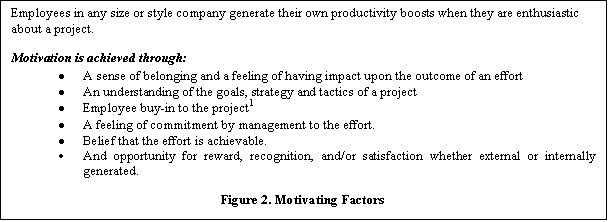
The huge baby-boomer generation that spurred a vibrant expanding economy is being followed by a much smaller generation.Numerically, the available workforce is shrinking.Both industry and the military are beginning to feel a shortage of experienced staff in certain fields.This shortage will worsen under current employment models as the baby-boomer retirement curve peaks.Many obstacles are in place to prevent the extension of work beyond traditional retirement ages and re-entry into the workforce by retired staff.
The economic boom of the 1990’s has created a financial freedom based upon investments rather than solely retirement plans and social security income for many baby-boomers.This financial independence spurs aging boomers to retire early and to be less tolerant of perceived restrictions and obstacles at work.Many people of this generation enjoy working but are willing and able to give it up if the employment picture is not enticing.
Employers seeking the Generation-X employee have recognized a profound shift in priorities within this generation.Although not financially independent like their baby-boomer predecessors, they share a desire to experience more balance in their work and personal lives.Additionally, recruiting has had to resort to more creative offers to lure this generation of workers.Perks such as fitness club memberships, ability to telecommute at will, even ability to bring pets to the office share a common trait with the desires of the boomers – change the workforce model to make the work experience more rich, accommodating of personal life and enjoyable.
Accelerating Obsolescence.Especially hard-hit by the tighter labor market will be those products with long design to production cycles and those with long active life terms.Military aircraft are one such product.The accelerating rate of obsolescence in the electronics field means critical replacement parts are not only no longer made, but the companies owning the part specifications and designs may be out of business.Stockpiles acquired during initial provisioning for airplanes such as the C-130, F-15, and commercial planes such as the Concorde are dwindling as these planes flying life begins to exceed two decades.At the same time that specific parts used in these planes are becoming obsolete and increasingly unavailable, the technology needed to make the parts may also have become obsolete and commercially unobtainable.Cannibalization, reclamation, life of type buys, part substitution, reverse engineering, and replacement with newer technology or elimination through redesign are all methods being used to deal with obsolete parts[i].Even limited life extension becomes difficult to sustain without decreasing the number of operational units.
Proactive component lifespan evaluation in the design stage needs much improvement to prevent inclusion of parts nearing the end of their lifecycle in new designs.Determining a parts' future availability is more difficult than indicated.Designers often find parts that are familiar, and commonly in use, are rapidly moving towards discontinuance[ii].Even the most recent, 1990's generation upgrades to the F-16 General Avionics Computer (GAC) use some components on the verge of technological obsolescence including 8-bit MPU and STTL components.
These components' availability is waning and both are already only available sole source. Another telling example of the impact of long system life is demonstrated by the C-17 lifecycle.This system, first delivered in 1993, is expected to remain in service beyond the year 2040.During this same time span the technology lifecycle of parts is expected to decrease from an already short 3.5 years to 1 year – further increasing DMSMS problems.[iii] The table illustrates just how significant the extension of aircraft lifespans are in the context of generating DMSMS problems.
|
Aircraft
Type
|
No.
of Aircraft
|
Ave.
Age Now
|
Projected
Retirement
|
Age
at Retire-ment
|
|
C/KC-135
|
638
|
33
|
2040
|
79
|
|
B-52
|
94
|
34
|
2030
|
70
|
|
C-5A
|
77
|
25
|
2021
|
52
|
|
C-141
|
248
|
29
|
2010
|
45
|
|
F-15
|
940
|
12
|
2020
|
38
|
|
F-16
|
1727
|
7
|
2020
|
33
|
Building upon this illustration, lets examine a single system within one of these planes.Each of the 940 F-15’s uses an APG 63 Radar unit.Already 20% of the parts for this one system are not available.Estimates predict a cost of more than $70 Million dollars to maintain the avionics for this plane just until the year 2001[v].This cost will escalate at an even faster rate as the plane nears the end of its service life in 2020. [vi]
Improved parts procurement, flexible, upgradeable designs and other support methods may be able to meet the material aspect of maintainability but overlooks the critical knowledge aspect.Having a complete toolset or parts selection alone is insufficient without the “how” and more importantly the “why”. Lack of an understanding of the “why” aspect can easily lead to disaster.
During WWII, Battelle scientists worked to determine the cause of crashes of Japanese built planes which had been built based-upon reverse engineering and stolen US technology.Subtle misunderstandings by the Japanese had led to the stamping of part numbers onto gears in a place that created metal fatigue, stress, wear, cracks and eventually failure.Otherwise, the parts were a nearly identical replica of the original.This is just one example of the dangers of not understanding the “why”’s involved in the design.The aging of the US workforce and other factors above result in a tremendous loss of corporate knowledge.
Much of this knowledge is never passed on to newer employees due to issues as simple as a lack of duties overlap, a fractured promotion chain, and generational gaps.The rate of technological change continues to force academia to produce waves of graduates versed in the current or emerging technologies, yet who have little understanding or knowledge of previous technologies.
Older workers face similar challenges trying to keep abreast of the ever-changing technologies.
2.NEW
WORKFORCE MODELS.
Innovation occurs where market realities force it to. Start-up companies, especially in the information fields, have proven that the same dispersed tasks, use of collaboration tools and decision-making, and collegiate or peer–group structures instead of traditional hierarchies can produce effective, viable, and profitable corporations.A major difference is the perceived closeness in vision between the workforce and top management at many start-ups. The often smaller quantity of people involved creates a real and perceived feeling that each employee being an important cog in the realization of the result.
These start-ups have access and skills to implement robust technology-based infrastructures and but often do not have the cash flow to allow them to follow traditional models.In addition, the lack of company history reduces the observance of “status quo” thinking.
A small workforce increases each player’s impact upon the organization and creates a situation where management is grateful for employees to be tackling tasks rather than as in some existing organizations where the focus is on whether the employee is conforming to existing processes. New companies are frequently more open to experimentation and to “what works” whereas established companies are biased towards established procedures, roles, and internal political divisions of labor.
Employee Leverage Increases and Employee Demands Change.To counter the risks of working for an unproven company, their employees demand and are able to receive more flexibility in their work model from the startups.Flextime is only the beginning of such requests.
Equal treatment (both perceived and actual) for in-house and virtual staff, ubiquitous access to corporate information and support processes regardless of employee location, mobile technology, and collaborative tools, flexible use of ad hoc teams, and increased time off are a few of the common demands.These innovations in the workforce model are successful in great part due to the start–up company’s multiple level commitment.
Many viable programs have failed when a corporation’s workforce felt management was only paying lip service to it. Or when all levels of the hierarchy were not committed to it. A common failure point is when a company’s top management commits to an idea such as Total Quality Management or Employee Empowerment and does a direct sell to the worker level, assuming mid-level management will follow its lead.Unless upper management also creates buy-in with mid-management and changes processes to enable the program to succeed, mid-level management will become an obstacle, blocking success and creating mistrust and frustration with the workers.
Established, traditional firms must create a visible commitment to a new business model.These firms face increased hurdles in modifying established precepts, processes and embedded departmental rivalries.Thus the change must be strongly championed at all levels of management to succeed.
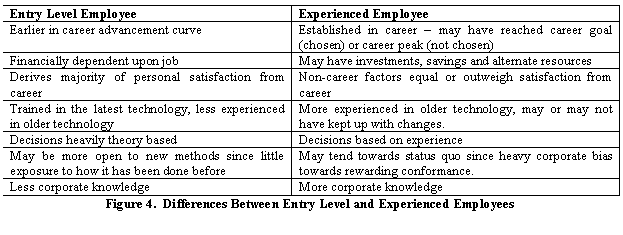
Valuation of experienced workers.Experienced workers provide not only a well -spring of corporate knowledge; they also have a work ethic and an understanding of the tenets of business beyond their immediate role.Corporations such as McDonalds have acknowledged the value of these benefits of the experienced worker.McDonalds Inc.is one of the largest employers of senior citizens in America.McDonalds gains further value from these experienced workers by teaming them with inexperienced workers.This valuation of the older worker has paid off in productivity and customer service benefits to the corporation.Similar gains can be made in defense and technology companies by changing the perception and corporate valuation of the experienced worker.
Youth bias is prevalent in current American culture.Recruiting and compensation traits within corporations reinforce this youth bias.Practices such as paying top dollar to attract untested college grads while keeping established employees’ pay rates near stagnant has led to the career practice of job-hopping within the certain fields.Employers end up paying higher rates to essentially exchange employees.
New Workforce Options.To fully utilize the workforce potential of the future companies will have to rethink all aspects of their current business.Changing worker requirements will need to play a larger role in determining the selection of benefits offered.Flexibility to choose from a cafeteria-style selection of benefits may become the optimal method of meeting varied employee demands.
Some
of the changes needed include:
Creating
Career Paths for individuals who stay in mature fields.This
retains a company’s ability to support “cash cow” operations at a lower
expense, reduces turnover in these roles, and lowers training costs while
maintaining quality of support.
Ex.
A company may need to migrate an existing product that is based upon a
proprietary Unix-flavored operating system to a Windows 2000 based, more
open architecture.While this migration
is the appropriate way to retain currency and attract new customers, a
large existing client base must not be ignored.The
existing client base will not move to the new technology as quickly as
new customers since they already have a large sunk-cost investment in the
existing technology, application, equipment, licensing, training and support.Retaining
these customers requires that the company maintain quality customer service
on this application until most customers have migrated. For products with
large sunk-costs, this migration could take several years.Without
creating a career path for experienced employees who remain with this product
throughout its ramp down period, the talent will follow the emerging technology.Soon,
the existing customer base is being supported only by those employees who
were not skilled enough to transition to a new field or by new hires.New
hires may be bright, skilled employees but the likelihood is that they
have been trained by academia on the emerging technologies and not on the
fading ones.This results in the
most loyal customers being given the poorest support.
Removing
Penalties for Company Loyalty.Career
path planning, rewards for loyalty and accurate valuation of experience
are needed to reduce the cycle of job-hopping which creates a salary escalation
across the board.
Reap
the Rewards from True Employee Empowerment. Employee
empowerment in name only is actually more harmful to moral than acknowledging
that decisions are made by a select group of individuals.Failure
to accept and consider input from all levels of employees fails to take
advantage of the specialized knowledge and creativity of each employee.Maximizing
employee input is a powerful tool to create leaps in customer service,
cost reduction, and creative marketing.Companies
who strive for quality within a framework of continuous change will stay
in a leadership role longer than those companies who struggle for perfection
at the expense of change.Richard
Branson, the world’s second youngest billionaire, constantly challenged
his employees to find creative ways to stay ahead of the competition.Through
this commitment to employee empowerment, Branson’s Virgin Atlantic Airlines
revenue growth to $700 million in just six years since inception.
Another
telling example of how effective empowerment of workers is can be seen
in a case study of Hewlett Packard (HP). When HP tasked its engineers to
decrease the defect rate of soldered connections, they developed suggestions
which cut the rate in half – from 4 to 2 per 1000 connections.Later
when HP tasked the general workforce with the same task, the resulting
suggestions cut the defect rate to fewer than two defects in one million
connections. [vii]
Create
Co-evolution of the Corporation Through Relating Technological Revolution
with Employment and Managerial Revolution. Arie
de Geus, head of Royal Dutch Shell sums up the need for corporate knowledge
in his statement, “The ability to learn faster than your competitors
may be the only sustainable competitive advantage.” Technology advances
have created the ability to gather vast stores of corporate data.Corporations
have learned through tough, expensive lessons that having data is not equivalent
to knowledge.Further, knowledge
is only useful if it is acted upon.
Therefore,
this data must be linked together in meaningful ways to maximize effectiveness
and employees and managers must have access to the data as well as guidance
on its meaning and constraints.Managers
must evolve from the information-keepers to a coaching role of showing
employees how to use the available knowledge.Finally,
corporations must be willing to evaluate and act upon recommendations made
by employees.
Manage
Information Dissemination Decisions with a Corporate-Wide View. Careful
selection of information recipients or collaborators is needed across the
board.This selection may include
non-traditional recipients such as external partners, customers, and lower-level
employees. Collaborators can also be automated processes.Top
management must be involved in these decisions and not delegate without
oversight to sub-organizational structures who may not fully grasp the
broader corporate strategies.
Wal-Mart
is an example of the profitability of tight communication binds with external
partners.When a light bulb is sold
at a Wal-Mart, automated information processing applications determine
the manufacturer of the sold item and alert both inventory to restock the
item and the manufacturer that an order will be forthcoming.Completing
the Electronic Data Interchange (EDI) process is an automatic payment loop.
Political
inter-departmental power ploys must be acknowledged and reviewed for their
benefit to the corporation and removed when found harmful.One
frequent source of information restriction is the internal information
services/technology (IS or IT) department.Policies
and processes in this department especially require senior management oversight
by someone with a broad view of corporate-wide goals and strategies since
the IT Department has the physical means to control and to limit information
flow.Information-restricting policies
are needed to retain control over proprietary data, prevent unauthorized
access, and create levels of detail access (such as for sensitive information).Virtual
Private Networks (VPN), encryption technologies, global satellite networks,
and firewall technologies make securing data while allowing remote access
to employees and partners worldwide is already available.
However,
many IT Departments have created a power-base by becoming the ultimate
authority on data access – acting like a line rather than a staff organization.One
fortune 500 company spent several million dollars on a project to tie their
support staff directly into customer systems – only to have the IT department
initially prevent the companies own support staff from gaining access to
the data.This situation was quickly
remedied when a higher executive stepped in but clearly illustrates the
potential for information restriction by a department at the expense of
the organization.
Encouraging
New Definitions of “Employment”.Expansion
of the concept of employment to allow not just part and full time employees
but also ad hoc, virtual, post-retirement and other definitions will maximize
a company’s ability to hire and retain productive, motivated, and profitable
workforces.Attaining a balance of
teams and individual contributors is one method of reinvigorating the workforce.
Creating
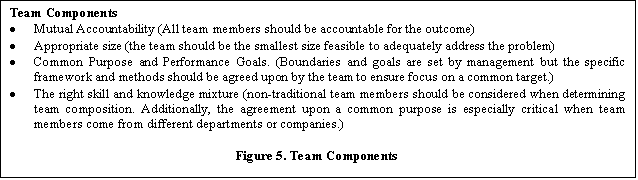
successful teams means understanding the components of effective teams
and an ability to create, reform and disband dynamic teams as needed.Including
non-traditional members on teams such as virtual staff, customer or vendor
representatives, and consultants can improve the decision–making outcomes.Too
often a group of people are called a “team” when in fact they have individual
goals and accountability.
Acceptance
and nurturing of selected individual contributors is a concept that many
companies mistakenly believe they already do.The
act of creating individual goals and evaluation does not foster the types
of innovative leaps possible when entrepreneurial type employees are truly
nurtured.These types of employees
see what can be – they see the world in radical new ways.Harnessing
this ability to innovate rather than requiring its conformance to the status
quo is a difficult task for many corporations. One which is compounded
by the often difficult nature of entrepreneurial people.
Another
difficult task is creating equality when valuing amongst different types
of employment roles: part-time, full-time, ad hoc, virtual, and others.Part-time
and ad hoc employees may, in future, be the most highly skilled employees
rather than those at the lower end of the skill and compensation spectrum.
Virtual or telecommuting options currently are often limited to roles having
a single input and output.Technology
already can support virtual leadership roles requiring multiple inputs
and multiple outputs.This model
is especially viable where team members are already geographically dispersed.Little
advantage is gained solely by bringing such a leader into the physical
office if the infrastructure can support a virtual setting[viii].Management
often lags in ability to equally weigh these unseen activities with those
of the in-house person seen daily around the office.
Remove
Barriers to Returning and Late Career Employees.Companies
are beginning to realize they have created, trained, and retired their
own best knowledge pool.Still many
penalties exist which hamper the re-entry to the workforce of retired employees
or employees who take extended leaves from traditional employment or who
wish to stay employed but with significant leave opportunities.Given
a market where past employees are financially independent – companies must
offer alternative enticements.
Example
alternative incentives include: a) the ability to freely enter and leave
the workforce with limited penalties b) allowing employees to continue
their retirement draws uninterrupted whether they return to work on a full,
part or temporary basis c) streamlining paperwork by creating an internal
“experts bureau” d) creating recognition and prestige rewards such as “emeritus”
status for senior and returning employees to off-set the youth bias e)
create infrastructure to remove geographic boundaries f) create new roles
outside of the traditional hierarchy g) offer continuing education opportunities
h) encouraging thoughtful experimentation and risk-taking – allowing for
failures.
Being
able to tap this pool of workers enables companies to:
·Access
corporate and general pools of knowledge
·Meet
labor demand peaks
·Create
product migration teams consisting of older and newer technology experts.
·Create
informal mentoring in hard and soft skills by creating cross-generational
worker teams.
3.CONCLUSION
AUTHOR
BIOGRAPHY
 BJ
Moore is President of Lida Ray Technologies (LRT), and acting vice president
of the Strategic Consulting Division.LRT,
founded in 1978 by Ms. Moore, specializes in strategic corporate planning,
program management and project recovery, and technology insertion for global
initiatives for Fortune 500 multi-national clients.Ms.
Moore's span of control also covers the newly acquired Environmental Division,
as well as the Information Products Division.
BJ
Moore is President of Lida Ray Technologies (LRT), and acting vice president
of the Strategic Consulting Division.LRT,
founded in 1978 by Ms. Moore, specializes in strategic corporate planning,
program management and project recovery, and technology insertion for global
initiatives for Fortune 500 multi-national clients.Ms.
Moore's span of control also covers the newly acquired Environmental Division,
as well as the Information Products Division.Ms.
Moore specializes in global product rollouts integrating corporate policy
and technology across cultural boundaries.She
has been a guest lecturer for major corporations and conferences in the
USA and abroad.Her work been published
internationally in a variety of fields including multi-cultural program
strategy, accelerating obsolescence in critical defense weaponry, wireless
computing application strategies and emerging technology insertion into
legacy systems.She holds degrees
in Electronic Engineering, Computer Science, Management Information Systems,
and Business Administration.Ms.
Moore was the first non-government employee invited to serve on the Aeronautical
Systems Command Security Working Group.Ms.
Moore also serves on many professional committees in a local and national
capacity. She initiated and was Technical Program Chair of the First IEEE
International Conference on Wireless Networking Applications.In
2000, she was a recipient of the IEEE Third Millennium Medal for her past
IEEE (Institute of Electrical and Electronic Engineers) activities.
REFERENCES